Victoria
Station ElevenVictoria is the childhood friend Arthur Leander addresses as V. in the letters collected in Dear V.: An Unauthorized Portrait of Arthur Leander. Identified only late in the correspondence as Victoria, she is both a figure from Arthur’s island childhood and the recipient of his attempts to make sense of friendship across years of separation. The letters make her important not through a narrated account of her own life, but through the changing distance between what Arthur asks of her and what he believes she gives in return.
Identity and Place in the Letters
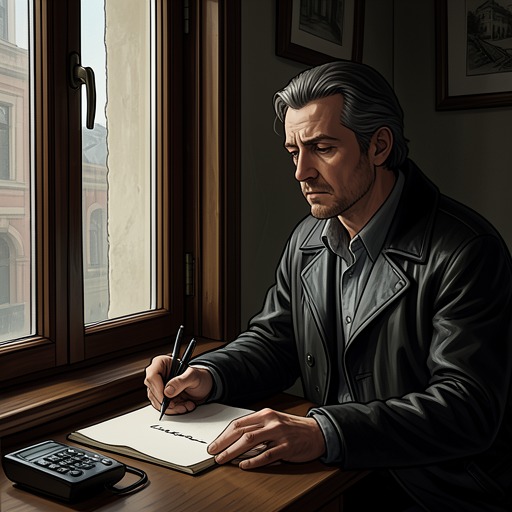
The book is composed entirely of letters Arthur writes to a friend identified as the anonymous V. Its title presents the collection as a portrait of Arthur, but the letters also form an extended, one-sided record of his relationship with Victoria. The reader learns her identity through Clark Thompson, who recognizes that V. is Arthur’s friend Victoria. Until that identification, the initial works as both a private form of address and a small withholding: the recipient is present throughout the correspondence, while her own words are not.
The book has a place in the post-collapse story beyond its contents. Kirsten Raymonde remembers it as a bestseller, its cover carrying a black-and-white photograph of Arthur turning to look over his shoulder as he gets into a car. The expression cannot be settled from the image: it might look haunted, or simply as if someone has called to him. That ambiguity suits a collection in which Arthur’s account of another person is available, but her response is not. Kirsten’s mother bought the book shortly before the end of everything; Kirsten later lost it on the road and kept looking for a replacement. Victoria’s presence therefore reaches the later world through a book that has become both a remnant of the old publishing culture and a surviving record of Arthur’s letters.
Childhood and the Island
Arthur’s letters place Victoria in the island world they shared as children. He remembers building forts with her in the woods when they were five. In a later recollection, he dreams of being in her house again, playing mah jong with her mother. He thinks they played only once, and remembers that they were both stoned, but dwells on the small tiles as a detail that has stayed with him.
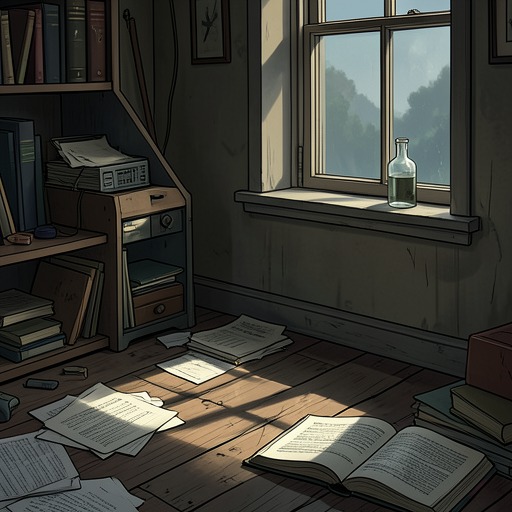
The house’s view of the ocean gives that memory a particularly clear shape. From the living room, the water seemed to begin at the end of the lawn; outside, a cliff stood between the grass and the sea, reached by a rickety staircase Arthur remembers as frightening. His description turns a familiar childhood place into an image of misleading nearness: what appears within easy reach from indoors is separated from the house by a dangerous drop. The detail belongs to Arthur’s memory, not to an account from Victoria, and its meaning remains open; the letters repeatedly make her life accessible only through what he recalls or chooses to tell her.
Their connection does not disappear when Arthur leaves the island. At nineteen, while considering an acting program in New York City, he writes as someone who has begun to doubt the friendship’s reciprocity. He says that Victoria will return his calls but never call first, and concludes that he has to judge the relationship by her actions rather than her assurances. This is Arthur’s assessment of the pattern, not an independently confirmed account of Victoria’s intentions. Its force lies in the contrast between his repeated reaching out and his belief that she does not reach back.
Distance and an Attempted Renewal
The correspondence also records what Arthur shares with Victoria while his life moves elsewhere. He tells her about Clark, a fellow student in his acting class, describing Clark’s half-shaved, pink punk-rock hair and conflict with his parents’ expectation that he pursue business school or another practical degree. Arthur says that Clark would rather die than take that path, and connects his understanding of the feeling to his own earlier desire to leave the island. The letter makes Victoria a witness to the people and choices through which Arthur explains himself, even as he worries that she has little interest in his life.
After what he describes as years, perhaps decades, without writing, Arthur addresses her again following a Christmas gathering. He had not known his mother planned to invite people over and finds the reunion awkward, but also wonderful: he is glad to see Victoria and speak with her after so long. He notices that she has four children, a fact that makes the time between their earlier friendship and their renewed contact suddenly tangible. He recalls that his mother would show him off when he returned to the island, although she would have preferred that he never leave and instead drive his father’s snowplough.
Arthur says Victoria is the first person he wants to tell about his impending marriage. He is marrying Miranda, an artist from the island whom he met in Toronto, and plans to move with her to Los Angeles the following month. He asks whether they can be friends again and tells Victoria that he has missed her. The letter does not establish how she answers or how their relationship develops after this appeal. It does, however, show Arthur returning to the friendship with a concrete bid for renewed intimacy: he shares major news, remembers their childhood, and asks directly for the bond to begin again.
A Friendship Seen from One Side
Victoria’s significance is inseparable from the form of the book that preserves her. Arthur’s letters move between remembered scenes, complaints about the present, and renewed declarations of attachment, but Victoria’s side of the correspondence is not included in the evidence presented by the novel. The reader can follow Arthur’s changing description of the friendship—childhood closeness, adult grievance, a long silence, and a hopeful reunion—without being able to verify his judgments about why she did not initiate contact or what she made of his return.
That imbalance does not make Victoria merely an absence. The details attached to her—the house above the cliff, her mother’s mah jong tiles, the childhood forts, and the four children Arthur sees at Christmas—give her a place in several periods of his life. Yet the letters preserve those details as Arthur’s acts of recollection and address. Victoria thus remains both a particular person in his past and the person to whom he keeps trying to explain his present. The late identification of V. as Victoria completes the mystery of the initials while leaving the central uncertainty intact: the published portrait reveals how Arthur remembers and wants the friendship, not the full story of what Victoria thinks of it.